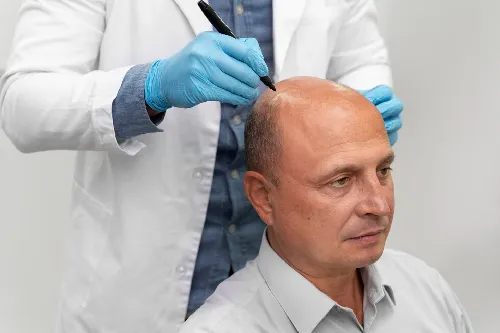

Hair loss is natural and normal if daily 50-100 hair strands are falling out and simultaneously replaced with new hair. But if that’s not happening, hair loss becomes an aesthetic concern. Most males at some point in their lives have this concern. For some, hair loss may not be confined to the scalp but may even affect other body parts. Thankfully, treatments can help address hair loss in men. A male hair transplant in Hyderabad, performed at Celestee Skin, Hair and Laser Clinic can be one of the options. This blog details male hair loss and the best time to get a hair transplant.
Causes of Hair Loss in Men
Men suffer from hair loss typically due to:
- Aging
- Family history
- Scalp infection or psoriasis
- Radiation treatment or chemotherapy
- Excessive stress
- Deficiency of iron, biotin, or zinc
- Se-xually transmitted infections like syphilis
- Some prescription medicines for arthritis, hypertension, heart conditions, depression, and gout
- Medical conditions like scarring alopecia, alopecia areata, trichotillomania, and underactive/overactive thyroid.
Early Signs You May Need a Transplant
A hair transplant might be considered by men when:
- Experiencing early signs of balding: receding hairline and hair thinning on the crown of the head
- Having a stable, generalised hair loss pattern
- Having a strong family history of pattern baldness
- Having enough donor hair and realistic treatment expectations.
Best Age for Hair Transplant Surgery
The best age for hair transplant in men ranges between late 20s and early 40s. It’s advised to consult a dermatologist for hair loss and ask about the right age or time to get a hair transplant.
Hair Loss Stages and Norwood Scale
Men’s hair loss, specifically pattern baldness, is classified into 7 stages, ranging in severity, as per the Norwood Scale. Understanding each stage can help one understand the hair loss progression and know potential treatments.
Here are 7 hair loss stages with distinct features:
| Stages | Features |
| 1 | Minimal to no loss of hair; hairline recession started, but is not visible |
| 2 | Maturing hairlines; slight recession noticed around the temples |
| 3 | “M” shaped hair loss (crown balding); deep hairline recession |
| 3 A | A hairline recession with less pronounced dips; less severe hair loss than stage 3 |
| 3 Vertex | Maturing hairlines with considerable hair loss on the crown of the head |
| 4 | A severe hairline recession; U-shaped hair loss with considerable hair loss at the crown, separated by a hair strip |
| 4 A | A uniform hairline recession without dips and bald spots on the crown |
| 5 | More significant hairline recession; thinner hair strip separating the receding areas |
| 6 | Hair loss covering the temples and crown, with minimal to no hair left out in between |
| 7 | Most advanced hair loss; a thin hairband left at the sides and back of the head |
Should You Wait or Act Now?
If suffering from hair loss, no need to promptly act and seek a hair transplant. It is generally recommended for hair loss sufferers to wait to have a stabilised hair loss pattern before considering a hair transplant. Waiting allows more accurate assessment of hair loss and guarantees more seamless, head-full of natural, thick hair.
Hair Transplant in the 20s Vs 30s Vs 40s
There are some pros and cons of considering a hair transplant at different ages.
- In the 20s– The results are more natural-looking, as a lower hairline can age well with time. But hair loss patterns may not be stabilized, and donor hair may not be used most effectively.
- In the 30s– Hair loss pattern is stable, so there is better planning and outcomes of hair transplant. However, some may still experience hair loss and require a second hair transplant.
- In the 40s– Hair loss is stable, allowing for predictable hair transplant results. The patient has a more mature perspective on his needs and expectations. However, hair transplant coverage may be influenced due to slightly reduced donor hair strength and density at older ages.
Alternatives Before Choosing Surgery
Before considering a hair transplant, men suffering from hair loss should explore the following non-surgical treatments:
- Medications– Rog-aine (Min-oxidil) is an over-the-counter topical medicine to stimulate hair regrowth. Pro-pecia (Finaste-ride) is an oral prescription drug to delay hair loss and promote hair regrowth. Dutas-teride is a prescription medicine that blocks the formation of dih-ydrotestos-terone hormone, responsible for hair loss. A hair loss specialist may recommend any of these medications, as per the individual case.
- Therapies/Procedures– A hair loss doctor in Hyderabad may recommend some procedures that promote hair regrowth. These include low-level light therapy, microneedling, hair mesotherapy, P-R-P therapy, and GFC therapy.
- Scalp Micropigmentation– It is a cosmetic procedure where medical-grade ink is inserted into the bald areas of the scalp to create an illusion of a shaved head.
- Others– Hair fall can be stopped and hair growth can be supported with scalp massage and use of supplements like Vitamin D, E, biotin, and iron, which are linked to hair growth.
FAQs on Hair Loss in Men
What’s the ideal age for a hair transplant?
Ideally, men should get a hair transplant when aged between 25 and 30 years. That’s only when they have stabilised hair loss, emotional maturity, enough donor hair availability, and good overall health.
Can I get a transplant if I’m still losing hair?
Yes, but the transplant success will be compromised. Hair transplant is effective only when it is performed to address stabilised or stopped hair loss.
Will I need a second procedure later?
Probably yes, if there is further hair loss or the first hair transplant outcome was unsatisfactory or had complications. To know if a second hair transplant is necessary, consult with a hair transplant surgeon.
Is it okay to start with medications first?
Yes. Dermatologists or hair doctors usually recommend min-oxidil or finas-teride medication as a first-line treatment for hair loss in men.
How early is too early for a transplant?
Typically, men aged under mid-20s are not recommended for a hair transplant because their pattern baldness may still be developing. Too early a hair transplant could provide unnatural results, and also, there is potential for premature depletion of the donor area.
Do hair transplants work at all stages of baldness?
Yes, hair transplants work well for mild to advanced stages of baldness. However, the surgery outcome and the number of grafts required will vary based on the stage of baldness.
Hair loss in both men and women is common nowadays. To tackle this concern, one can opt for hair loss treatments in Hyderabad, provided at Celestee Skin, Hair, and Laser Clinic. The team of doctors offers state-of-the-art treatments for managing hair loss.
Book a visit to learn more about these procedures in detail!