Our skin is the largest organ of our body that intends to safeguard our vital internal organs from any damage or injury. However, an injury/trauma to the skin like a burn, severe acne breakout, a serious wound, or surgery can heal but can cause the formation of scars.
The definition of scar can be given as a permanent mark caused by fibrous tissues due to post-injury on the skin. As there are multiple causes of scars, there are different types of scars that can be formed. How scars appear largely depends on the type and location of the wound and even other factors such as age, heredity, se-x, and ethnicity. Small scars might fade over time but most scars remain forever. For larger or more noticeable scars that are bothersome or discomforting, dermatologist-recommended scar treatment in Hyderabad at Celestee Skin, Hair and Laser Clinic can help reduce the size and appearance of the scars.
Given below are various types of scars- their causes, treatments, and prevention.
Types of Scars
Different types of scars can develop as a skin wound heals. Scars on the face are very prominent and impact one’s aesthetics.
- Keloid Scars
Keloid scars can be identified as irregularly shaped, thick and raised scars. The scar can be either red or dark in colour. Moreover, scars are often present at the site of the pre-exiting wound. They appear anywhere on the body after up to 1 year of injury. This scar typically effects individuals with darker skin tones. Moreover, these scars are more common around chest, back, near earlobes, and shoulders There is no single treatment that would work for keloid scar. Keloid scar removal options include cryotherapy, steroid injections, silicon diox-ide, pressure therapy, radi-ation therapy, and laser surgery. - Hypertrophic Scars
These are thick scars similar to keloid scars with the only difference being that scar tissue overgrowth remains confined within the original injury borders. They start developing within a few weeks after the skin injury.
A hypertrophic scar can improve within a course of time, and it may take up to years to become negligible. It can be treated with a silicone dioxide application or steroids. - Atrophic Scars
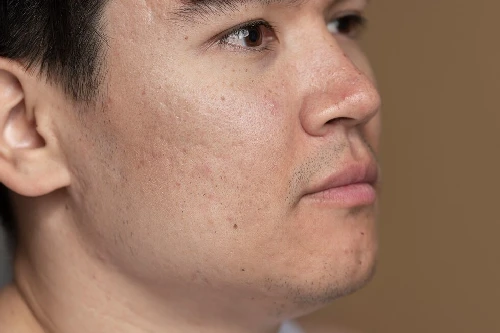
These are round, pitted scars, one of the acne scar types and scars on the face that form within the original wound. Based on their shape and depth, they are further classified as icepick scars, rolling scars, and boxcar scars. Their treatment options include chemical peeling, lasers, radiofrequency, and microneedling. - Contracture Scars
Commonly referred to as burn scars or tight scars, these scars form when edges of the skin are pulled together due to great damage or loss of the skin. A skin contracture further negatively impacts tendons, muscles, and joints followed by shrinking and limiting the movement. Surgical interventions like skin grafts/flaps, Z-plasty, and tissue expansion can help treat contracture scars.
Causes of Scars
Our skin has different layers, the topmost being the epidermis and the underneath layers being the dermis, each having different cell types. If the epidermis is only injured, then the skin cell regenerates without leaving behind scars. However, if the injury goes deeper within the skin, the body goes into a natural wound-healing response, and this is how scars form.
During natural skin repair, the fibroblasts present in the dermis are stimulated to produce fresh collagen fibers. However, unexpected collagen growth is the reason for scars to develop. Indented scars form because of less collagen synthesis during the wound healing while raised scars form when there is excess collagen growth.
The different causes of scars include injury/trauma to the skin from burns, cuts, incisions, acne, or chicken pox.
Treatment Options for Scars
Scar removal treatment in Hyderabad is determined by a dermatologist based on:
- The treatment option is decided on the basis of type of scar, severity of condition, location and symptoms of the scar.
- The candidature for the scar removal treatment also depends upon the age of the patient, medical history and general health of the patient.
- The option for treatment also depends upon the patient’s tolerance and ability for specific medications, therapies and procedures.
- The expectations regarding how long the scar last
- The patient’s opinion or preference.
Scar remocal treatments do not completely remove or erase the scar. But it works by fading away the scars and improving the appearance and complexion of the skin. There is a diverse range of scar removal options available, including:
- Silicone dioxide: A silicone gel or pad is applied over the scar, preferably a raised scar, to soften and reduce its redness.
- Pressure therapy: A pressure appliance is worn all the time over the raised scar for up to 4-6 months.
- Chemical peeling: A superficial, medium, or deep peel is applied over the scarred skin to remove the affected skin layer and regenerate the skin. The type of chemical peel that will suit you best depends upon the depth of the scar along with the strength of the acid or peel.
- Steroid injections: The treatment approach targets harden scars, size of the scar, itching, and redness of the scar. Moreover, it also helps in reducing the burning sensation.
- Collagen injections: These are filler injections that are recommended to treat indented scars.
- Low-dose radiation therapy: This is rarely recommended, only when other treatments have failed to work.
- Laser treatment: There are different types of medical-grade lasers available to smoothen scars, get rid of unusual scar colour, or flatten a scar. The types of lasers used for laser scar removal include pulse dye lasers and fractional CO2 laser therapy.
- Dermabrasion: This technique uses an electrical device that works by sanding off and removing the superficial layer of the skin. The treated skin heals and appears smoother and refreshed.
- Cryotherapy: This therapy involves freezing the scarred tissues to cause blisters to form.
How to Prevent Scars?
Preventing scars is possible if there is proper wound and scar care. The recommendations for minimizing scars include:
- Apply proper scar-reducing/wound-healing products
- Avoid excess movement of the body part with scarred skin
- Avoid picking at the scabs
- Keep the wound clean, moist, and covered
- Avoid massaging scar as it break up the scar tissues.
- Sun-protect the wound
- Use pressure garments.
Risks and Considerations in Scar Treatment
Choosing the right scar treatment, based on the size, location, and type of scar is very important, which a dermatologist can help determine. If an appropriate scar treatment and dermatologist are not selected, there are more chances of experiencing serious side effects of scar removal.
The potential scar treatment risks include:
- Allergic reactions
- Bleeding
- Blistering
- Change in skin color
- Increased sensitivity to sunlight
- Infection
- Skin crusting
- Skin irritation/discomfort
- Swelling.
Get Scar Removal Treatment in Hyderabad
Scars naturally form in response to an injury to the skin, possibly as a reminder of burn, surgery, a cut, or acne. Their appearance varies depending on the extent and location of the injury and an individual’s age, skin type, and genetic makeup. With personalized scar care and appropriate scar removal treatment, scar appearance can be minimized. To find out which scar removal option will be effective for you, it’s important to schedule a scar treatment consultation.
FAQs on Scar Removal Treatment
What is the Best Treatment for Keloid Scars?
A dermatologist can help determine the best treatment for keloid scars as per their severity and location. The treatment options include steroids, silicone dressings/gels, laser therapy, pressure therapy, cryotherapy, radiation therapy, and calcium channel blockers.
Can Scars on the Face Be Completely Removed?
Facial scars won’t permanently clear off the skin. Treatments can only help them become less noticeable over time.
How Does Laser Scar Removal Work?
Ablative lasers work to thermally destroy and peel off the outermost scarred skin layers while boosting collagen growth in the scarred tissues. For less subtle results, non-ablative lasers are used. They only work to fill in indented scars by stimulating fresh collagen production.
What Causes Keloid and Hypertrophic Scars?
Keloid and hypertrophic scars are both an outcome of unusual healing of deeply injured skin or severe acne-affected skin. They are the result of excessive collagen growth as the dermal injury heals.
Are Scar Removal Treatments Painful?
Scar removal treatments may cause pain or discomfort, especially if the procedure is more invasive. The pain intensity depends on the treatment type, the scar’s depth, and one’s pain tolerance level. Thankfully, the pain is manageable with topical anesthesia and painkillers.
To get the best scar removal treatment in Hyderabad get in touch with the skin experts at Celestee Skin, Hair and Laser Clinic.